This industrial infrared lamp is a 300 W infrared illuminator designed to provide IR illumination for cameras and to serve as a machine vision illuminator. Its triggered infrared illumination synchronises the high-power IR LED array with image capture, while offering dimmable IR illumination, Modbus RS485 control and a rugged IP66 illuminator enclosure for industrial night vision and video surveillance. A compact IR illuminator for demanding installations.
The lamp features a RISC-V-based control architecture running FreeRTOS, Ethernet and RS485 communications and Modbus protocol support, allowing integration into industrial systems and control platforms.
Illumination intensity, activation delay and pulse duration can be configured electronically, and firing can be initiated via an external trigger input or by communication commands.
High-power infrared illumination
The lamp integrates an infrared LED array with up to 300 W of power, providing a high-intensity IR light source.
It is designed for applications where a scene must be illuminated without visible light and can be paired with cameras sensitive to the infrared spectrum.
Electronic dimming allows the light output to be matched to the conditions of each installation, optimising illumination as well as power consumption and thermal behaviour.
External trigger firing
The electronics include a trigger input for synchronising illumination with external devices.
This is particularly useful when the lamp works together with cameras, sensors or machine vision systems, as illumination can be generated only for the interval required for image capture.
Both the delay before switch-on and the illumination duration can be configured relative to the received trigger.
This enables precise synchronisation of:
- Trigger
- programmable delay
- IR activation
- programmable duration
- switch-off
Command-based activation
In addition to the hardware trigger, the lamp can be controlled by commands received through its communication interfaces.
This allows illumination to be switched on or off from a remote controller, operating parameters to be modified and the lamp's behaviour to be adapted dynamically to the needs of the application.
Combining a physical trigger with communications-based control offers great integration flexibility.
IR LED intensity control
The electronics control the illumination intensity of the infrared LED array.
The power level can be set according to distance, ambient conditions, camera sensitivity or the specific needs of the vision system.
This allows the same illuminator to be used in different scenarios and avoids running the LEDs at full power when it is not needed.
Ambient light sensor and dusk detection
The lamp includes an ambient light sensor that automatically detects outdoor lighting conditions.
This information can be used to implement a dusk detection function, preventing the infrared illumination from switching on during daylight.
When ambient light falls below the configured level, the system can automatically enable the lamp.
This strategy reduces energy consumption, lowers the thermal load and extends the service life of the illumination system.
Temperature and humidity sensor
The unit includes a temperature and humidity sensor to monitor ambient conditions and system operation.
Temperature measurement is particularly important in a high-power lamp, as it allows thermal conditions to be monitored and protection mechanisms against excessive temperature to be implemented.
Ambient data can also be used for diagnostics, preventive maintenance or logging of operating conditions.
RTC and time-based scheduling
The electronics include an RTC (Real-Time Clock) that provides an independent time reference.
The clock can be used to log events with date and time, set scheduled behaviours or complement dusk detection with time-of-day criteria.
Combining the RTC and the ambient light sensor enables advanced automatic operating strategies adapted to the day/night cycle.
RISC-V and FreeRTOS architecture
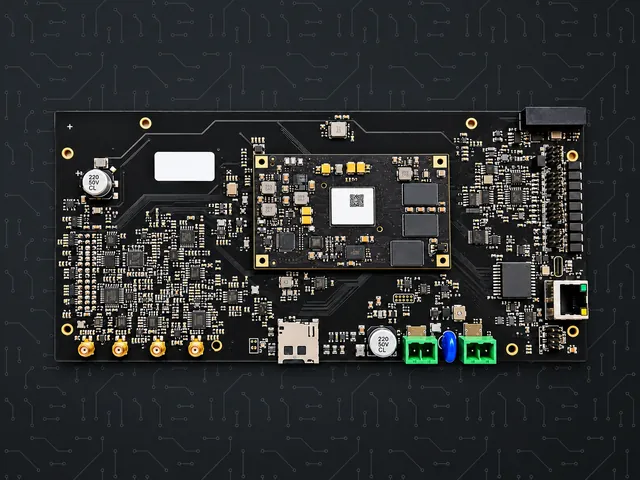
Lamp control is based on a RISC-V architecture running the FreeRTOS real-time operating system.
The firmware concurrently manages communications, the external trigger, pulse timing, power regulation, ambient sensors, the RTC and diagnostic functions.
Using an RTOS supports deterministic control of the various processes and is especially well suited to applications that require precise illumination timing.
Ethernet, RS485 and Modbus
The lamp features Ethernet and RS485 communication interfaces, simplifying integration into both networks and wired industrial systems.
Modbus support provides access to configuration parameters, states and system variables from PLCs, industrial controllers and other compatible platforms.
Parameters such as illumination intensity, timing, operating modes and diagnostic states can be managed over the communication links.
Rugged IP66 design
The enclosure is designed to provide IP66 protection, allowing the unit to be used in industrial and outdoor installations exposed to dust and water.
The rugged aluminium construction provides mechanical protection for the electronics and also plays a key role in the thermal management of the lamp.
Thermal management through the aluminium structure
Heat dissipation is an essential element in a 300 W LED illumination system.
The LED array is mounted on an aluminium substrate, promoting the transfer of the heat generated to the structure.
The aluminium body itself acts as a heat sink, spreading and removing the heat produced during operation.
This architecture combines mechanical support and thermal management within the construction of the unit itself, reducing the need for additional external components.
IR-transmissive front window
The LED array is protected by a plastic front window selected for its transmission at the infrared wavelength used.
This window shields the internal components from the environment while maintaining high transmission of IR radiation to the outside.
Applications
The lamp is especially suited to machine vision, infrared video surveillance, automatic image recognition and capture, inspection systems, industrial cameras, access control, night-time monitoring and synchronised IR illumination.
The ability to synchronise illumination via trigger makes it particularly attractive in applications where camera and illuminator must work in a coordinated manner.
Technical specifications
| Type | Industrial infrared illuminator |
|---|---|
| Power | Up to 300 W |
| Light source | IR LED array |
| Intensity control | Dimmable |
| Activation | Trigger / command |
| Trigger delay | Configurable |
| Illumination duration | Configurable |
| Processor | RISC-V architecture |
| Operating system | FreeRTOS |
| Ethernet | Yes |
| RS485 | Yes |
| Protocol | Modbus |
| Ambient light sensor | Yes |
| Dusk detection | Yes |
| Temperature / humidity | Yes |
| RTC | Yes |
| Protection | IP66 |
| Front window | IR-transmissive |
| Structure | Aluminium |
| LED substrate | Aluminium |
| Thermal management | Dissipation through the structure |