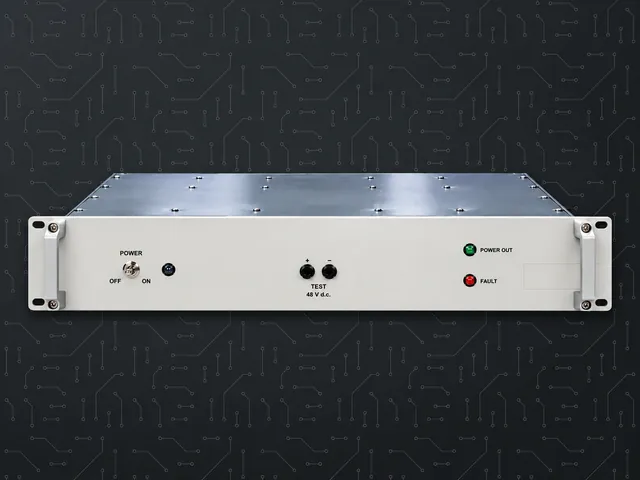
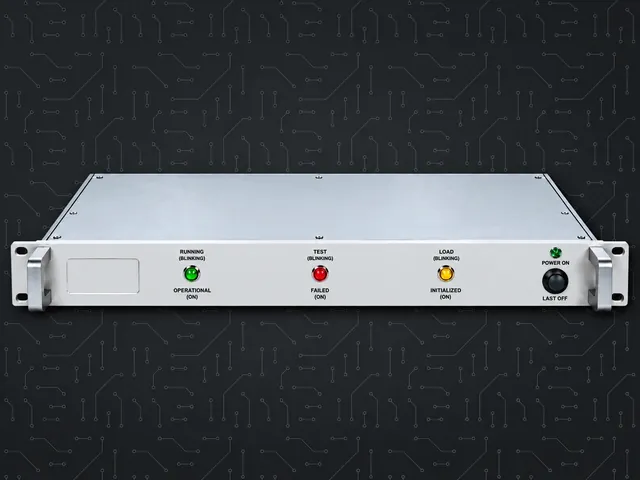
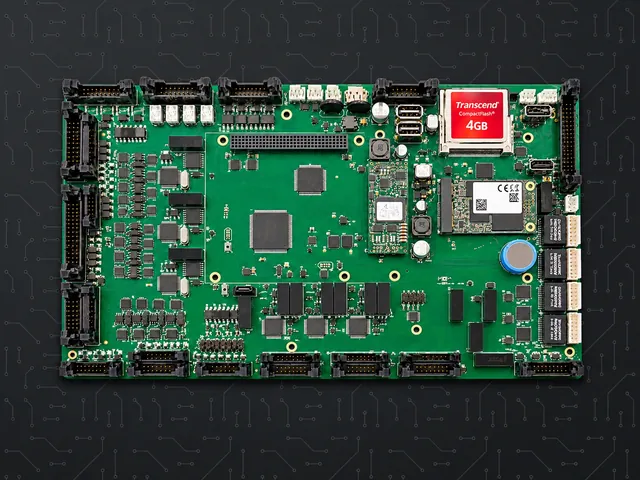
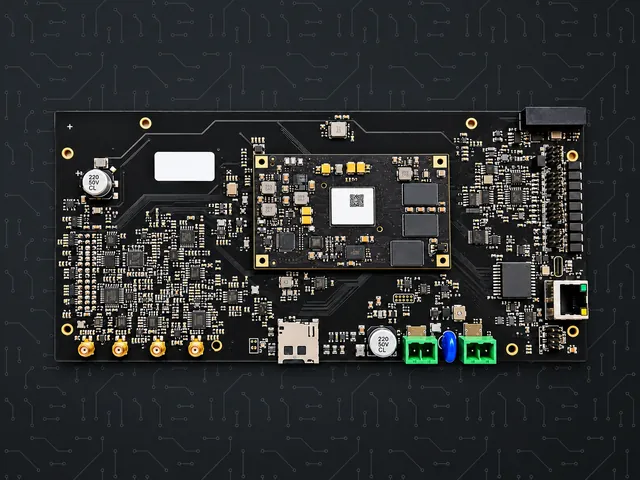
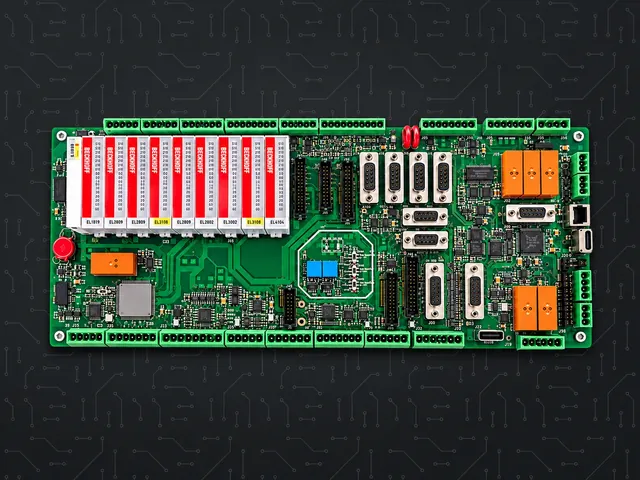
This 48 V solar charger manages installations of up to 1 kW, making it a complete 1 kW solar charger: photovoltaic battery charger, Ethernet solar charge controller and solar energy monitoring unit in a single enclosure. It is a RISC-V solar charge controller built as an industrial solar charger for off-grid solar applications, ready to work as a 48 V battery charger within an energy management system.
The unit is based on a RISC-V architecture running the FreeRTOS operating system and features Ethernet communications, control inputs and outputs, monitoring of the main electrical parameters and a USB-C configuration and diagnostics interface.
The electronics continuously measure solar panel voltage, battery voltage, current supplied to the load and battery charging current, so that the various power flows in the system can be calculated and monitored.
It is built into an anodised aluminium enclosure with passive heat dissipation, using the enclosure itself as the heat sink and providing a compact, rugged solution for off-grid energy installations.
Solar energy management up to 1 kW
The unit is designed to manage photovoltaic systems of up to 1 kW, controlling the flow of energy between the solar panels, the battery and the connected load.
The electronics continuously monitor the electrical variables needed to determine the energy status of the installation and to manage the charging process safely.
The overall architecture can be represented as follows:
- Solar panel
- Smart charger
- 48 V battery
- Load
The integrated measurement system shows in real time how energy is distributed between the different elements.
48 V battery systems
The platform is developed to work with 48 V storage systems, which are common in off-grid solar installations and industrial applications.
The controller constantly monitors battery voltage and charging current, providing the information needed to control the energy process and detect abnormal conditions.
Real-time electrical monitoring
The unit integrates several acquisition circuits to monitor the main electrical parameters of the installation.
The monitored variables include:
- Voltage from the solar panel
- Battery voltage
- Current supplied to the load
- Current used to charge the battery
- Power delivered by the photovoltaic system
- Power supplied to the load
- Power used to charge the battery
- Internal system temperature
- This information gives a complete picture of the energy behaviour of the whole system
Solar panel voltage measurement
The electronics continuously measure the voltage supplied by the photovoltaic panels.
This measurement allows generation conditions to be monitored and provides essential information for controlling the operation of the solar system.
Combining voltage and current also makes it possible to determine the instantaneous power available from the panels.
Battery supervision
The charger continuously measures the voltage of the 48 V battery, allowing its behaviour to be tracked during charging and discharging.
Together with the current measurement, the system has the information needed to determine the electrical behaviour of the energy storage.
Independent current measurement
The system distinguishes between the current supplied to the load and the current used to charge the battery.
This shows how the available energy is being distributed at any given moment.
In this way, different operating scenarios can be identified:
- Solar generation
- Load supply
- Solar generation
- Battery charging
- Solar generation
- Load + battery
The information obtained can be used for control as well as for monitoring and diagnostics.
Power calculation
From the voltage and current measurements, the controller can determine the instantaneous power associated with each energy flow.
This provides information on the power generated, the power consumed by the load and the power going to storage.
Power monitoring makes it easier to analyse the energy performance of the installation and to detect abnormal operating conditions.
Temperature monitoring
The unit includes temperature measurement to monitor its thermal operating conditions.
Thermal information can be used to control the behaviour of the charger and protect the electronics from unsuitable temperature conditions.
This supervision is particularly important in a power system capable of handling up to 1 kW.
RISC-V architecture
The charger is based on a RISC-V controller that handles acquisition of the electrical variables, control algorithms, communications and inputs/outputs.
The platform monitors voltages, currents, power and temperature in real time, coordinating the operation of the various subsystems.
FreeRTOS operating system
The firmware is developed on FreeRTOS, distributing the charger's functions across independent tasks.
The software architecture can separate functions such as analogue acquisition, energy control, Ethernet communications, input and output management, thermal supervision, diagnostics and the USB-C interface.
This structure supports the development of a deterministic, robust control system.
Ethernet communications
The unit features Ethernet connectivity, allowing it to be integrated into supervision and control systems over a wired network infrastructure.
The interface can be used to access operating parameters, read measurements and status, or integrate the charger into a higher-level energy management installation.
Ethernet connectivity turns the charger into an active element within an IoT or industrial energy monitoring architecture.
Control inputs and outputs
The platform provides digital inputs and outputs for interacting with external elements of the installation.
These interfaces can be used to receive status signals, control actuators or implement enable, alarm and interlock signals.
The availability of I/O broadens the possibilities for integrating the charger into more complex photovoltaic installations.
USB-C for configuration and diagnostics
The unit has a USB-C connector with a Shell interface, providing local access to configuration, maintenance and monitoring functions.
A command console provides a direct technical interface to the system during installation or maintenance.
The Shell can be used to read parameters, check measurements, change settings and carry out diagnostic tasks without accessing the Ethernet interface.
Local diagnostics
The combination of the USB-C Shell and internal monitoring provides diagnostic tools during commissioning.
The technician can access the controller directly and check parameters such as voltages, currents, power, temperature, input/output status and communications.
This considerably simplifies installation, maintenance and troubleshooting.
Passive cooling via aluminium enclosure
The electronics are housed in an anodised aluminium enclosure designed to act as a heat sink.
Heat generated by the power components is transferred to the structure, using the outer surface and its fins to aid dissipation.
This architecture reduces the need for active cooling and results in a compact, rugged system.
The absence of fans also eliminates mechanical parts subject to wear and reduces maintenance requirements.
Designed for continuous operation
The combination of electrical monitoring, thermal supervision and passive cooling makes the device suitable for applications that require prolonged operation.
The aluminium housing also provides mechanical protection for the electronics and simplifies integration into industrial or energy installations.
Remote supervision
The Ethernet interface allows the charger to be integrated into a monitoring platform from which the behaviour of the photovoltaic system can be reviewed.
Voltage, current, power and temperature data can be used to analyse the status of the installation, carry out diagnostics and build operating histories.
The architecture supports an information flow such as:
- Solar panel + battery + load
- RISC-V charger
- Ethernet
- Supervision system
Key advantages
- Management of solar systems up to 1 kW
- Designed for 48 V systems
- Independent measurement of panel and battery voltage
- Measurement of current to the load and to the battery
- Calculation and monitoring of system power flows
- Temperature monitoring
- RISC-V + FreeRTOS architecture
- Ethernet connectivity for remote supervision
- Inputs and outputs for integration with other systems
- USB-C Shell for configuration and diagnostics
- Fanless passive cooling
- Anodised aluminium enclosure acting as heat sink
- Compact, rugged design for energy applications
Applications
The system is intended for off-grid solar installations, 48 V photovoltaic systems, power supply for remote equipment, telecommunications infrastructure, IoT systems, industrial facilities and applications with battery energy storage.
The platform is particularly attractive when, in addition to energy management, remote monitoring, local diagnostics and integration with other control elements are required.
Technical specifications
| Device type | Smart solar charger |
|---|---|
| Power | Up to 1 kW |
| System | 48 V |
| Architecture | RISC-V |
| Operating system | FreeRTOS |
| Communications | Ethernet |
| Service interface | USB-C |
| Local console | Configuration and diagnostics Shell |
| Panel voltage measurement | Yes |
| Battery voltage measurement | Yes |
| Load current | Yes |
| Battery charging current | Yes |
| Power calculation | Yes |
| Temperature measurement | Yes |
| Digital inputs | Yes |
| Digital outputs | Yes |
| Cooling | Passive |
| Heat dissipation | Through the enclosure |
| Enclosure | Anodised aluminium |
| Application | Photovoltaic systems / energy storage |