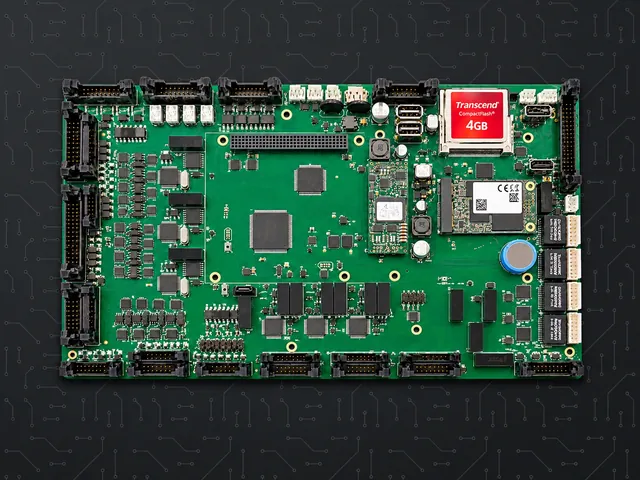
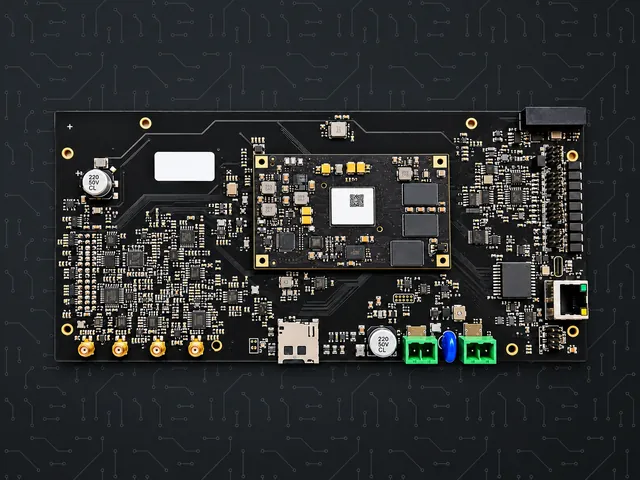
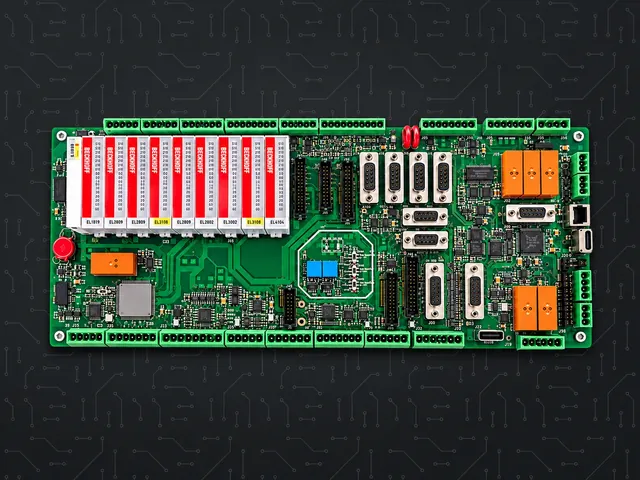
This industrial x86 FPGA controller combines an industrial COM Express module running Linux with an FPGA dedicated to inputs and outputs. As an FPGA-based controller, it works as a 24-bit data acquisition system thanks to its isolated industrial 24-bit ADC channels, and as a signal generator with 16-bit DAC outputs. With isolated RS485, industrial Gigabit Ethernet and a 10-inch HMI, it handles Linux data acquisition and control from a single unit.
The unit runs Linux and integrates Gigabit Ethernet communications, multiple isolated RS232/RS485 serial interfaces, high-resolution analogue acquisition, analogue signal generation and isolated digital inputs/outputs.
The hybrid COM Express x86 + FPGA architecture separates high-level functions —graphical interface, communications, processing and applications— from low-level peripheral management, providing a flexible platform for complex industrial systems.
The front panel features a 10-inch widescreen touch display for implementing a local HMI for system monitoring, configuration and control.
Hybrid x86 + FPGA architecture
The processing core is an x86 COM Express module that runs Linux and the main system applications.
Alongside it, an FPGA provides access to the various hardware peripherals and manages the input and output interfaces.
The architecture can be represented as follows:
- Linux application
- COM Express x86
- FPGA
- ADC / DAC / digital I/O / peripherals
This division lets the x86 processor focus on high-level functions while the FPGA handles the hardware interfaces efficiently.
x86 COM Express module
Main processing is carried out by a COM Express module, providing a modular and scalable architecture.
COM Express separates the CPU and its core resources from the application-specific electronics, implemented on a carrier board designed to provide the communications, analogue interfaces, digital I/O and other peripherals.
This modularity simplifies the evolution of the platform and allows processing power to be matched to different applications.
FPGA for peripheral management
The FPGA is one of the distinguishing elements of the system.
It acts as the interface between the x86 platform and the various electronic subsystems, managing access to:
- ADC
- analogue acquisition
- DAC
- analogue signal generation
- Digital inputs
- state acquisition
- Digital outputs
- actuation of external devices
- Peripherals
- interface control and synchronisation
This architecture makes it possible to implement application-specific logic and offload certain hardware management tasks from the main processor.
Linux operating system
The COM Express module runs Linux, providing a flexible environment for developing industrial applications.
Linux supports communications services, graphical interfaces, storage, data logging, diagnostics, network management and dedicated control applications.
The platform is especially well suited to systems that need to combine an advanced HMI with communications and data acquisition.
24-bit analogue acquisition
The system includes isolated 24-bit ADC channels for high-resolution analogue signal acquisition.
These channels allow analogue sensors and transducers to be connected while maintaining electrical isolation between the control electronics and the field signals.
The high resolution makes the platform suitable for applications where small variations in the acquired signals must be detected.
16-bit analogue outputs
The platform includes isolated 16-bit DAC channels for generating high-resolution analogue signals.
The channels can be configured as voltage or current outputs, making them easy to adapt to different types of instrumentation, actuators and industrial systems.
This allows the same electronics to control peripherals using different analogue signal standards.
Isolated analogue channels
Both the ADC inputs and the DAC outputs are isolated, providing electrical separation between the field circuits and the main electronics.
Isolation improves robustness against potential differences, electrical interference and certain ground-loop problems.
This is particularly relevant in distributed industrial systems.
Isolated digital inputs
The system includes isolated digital inputs to acquire states from sensors, contacts, control signals and other external devices.
These inputs are managed by the FPGA, allowing direct integration with the application's control logic.
Electromechanical relay outputs
The platform provides digital outputs via electromechanical relays, suitable for driving external loads and providing galvanic isolation.
The relays provide physical contacts for interacting with field devices with no direct electrical connection between the control circuit and the load.
Solid-state relay outputs
In addition to the electromechanical relays, the system includes SSRs (Solid State Relays).
Solid-state relays switch electronically with no moving mechanical parts and are suitable for applications requiring high switching frequencies or a large number of cycles.
Having both technologies available means the most suitable output type can be chosen for each load.
Up to 12 isolated serial ports
The unit offers up to 12 isolated serial communication interfaces, providing extensive connectivity with industrial peripherals.
The interfaces can include RS232 and RS485, allowing instrumentation, sensors, controllers and other equipment to be integrated.
Port isolation increases the robustness of the platform when connected devices are distributed across different areas of an installation.
RS232 communications
The RS232 interfaces allow direct connection of peripherals and equipment that use point-to-point serial communications.
This simplifies integration with existing instrumentation and devices, particularly in industrial installations with legacy interfaces.
RS485 communications
The RS485 ports provide robust differential communications, especially well suited to industrial environments.
RS485 supports longer distances and offers greater immunity to certain types of electrical interference than a conventional serial interface.
Up to three Gigabit Ethernet ports
The platform includes up to three 1 Gigabit Ethernet interfaces, providing high-speed connectivity for integration with industrial networks, servers, supervision systems and other equipment.
Multiple ports allow different networks or communication segments to be physically separated.
For example:
- Control network
- Ethernet 1
- Supervision network
- Ethernet 2
- Maintenance / services network
- Ethernet 3
This separation adds flexibility to the design of the communications architecture.
10-inch widescreen touch display
The front panel features a 10” landscape touchscreen driven by the x86 platform.
The display supports a complete local HMI showing variables, states, alarms, graphs and operating parameters.
It can also be used for configuration, diagnostics, maintenance and manual control of the system.
The combination of Linux and a large-format display simplifies the development of advanced graphical interfaces.
Integrated HMI
The graphical interface can centralise information from the various subsystems.
On a single screen, the operator can access:
- Digital states
- Analogue variables
- Control outputs
- Communications
- Alarms
- Diagnostics
- Configuration
This allows the unit to serve as a stand-alone control and monitoring station without installing an external computer.
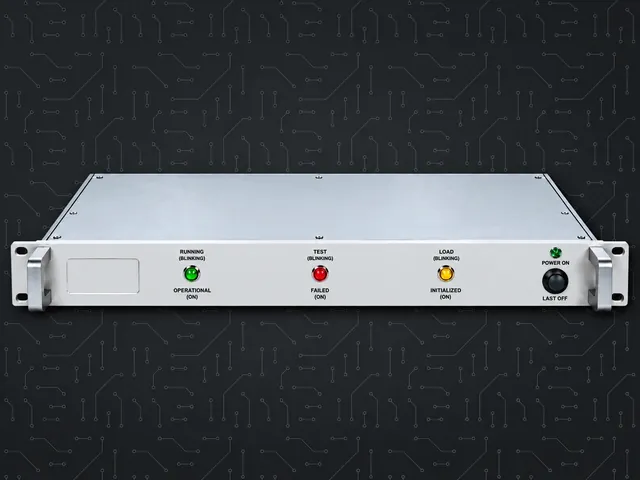
LED indicators
The front panel features power and status LEDs that give immediate visual feedback on system operation.
The indicators can be used to show power, run state, communications, alarms and other relevant application states.
Acquisition and control platform
The architecture performs acquisition, processing and actuation functions simultaneously.
The basic flow can be represented as:
- Sensors
- ADC / digital inputs
- FPGA
- COM Express x86
- Linux
- Control application
and for the outputs:
- Application
- x86
- FPGA
- DAC / SSR / relays
- Actuators
In this way, a single device can act as acquisition system, controller and HMI.
Isolation for industrial environments
A key feature of the platform is the isolation of the main field interfaces.
The analogue channels and communication interfaces are designed to provide electrical separation from the main electronics.
This makes the unit easier to use in complex installations where different pieces of equipment may operate with different electrical references.
Key advantages
- Hybrid COM Express x86 + FPGA architecture
- Linux operating system
- FPGA dedicated to peripheral and I/O management
- Isolated 24-bit ADCs
- Isolated 16-bit DACs, configurable for voltage or current
- Isolated digital inputs
- Electromechanical relay and SSR outputs
- Up to 12 isolated RS232/RS485 serial ports
- Up to 3 Gigabit Ethernet ports
- 10-inch widescreen touch display
- Integrated local HMI
- Modular and scalable architecture
- Acquisition, processing, communications and actuation in a single unit
Applications
The system is aimed at industrial control, data acquisition, plant monitoring, machinery automation, test benches, infrastructure control, instrumentation, supervision systems and advanced industrial gateways.
The x86 + FPGA + Linux combination is particularly attractive for applications that simultaneously require high processing power, numerous field interfaces and a local HMI.
Technical specifications
| Type | Industrial control and monitoring system |
|---|---|
| Main architecture | x86 |
| Processing module | COM Express |
| Co-processing / I/O management | FPGA |
| Operating system | Linux |
| Display | 10” touchscreen |
| Display format | Landscape |
| Ethernet | Up to 3 ports |
| Ethernet speed | 1 Gigabit |
| Serial interfaces | Up to 12 ports |
| Serial communications | RS232 / RS485 |
| Serial isolation | Yes |
| Analogue inputs | Isolated ADCs |
| ADC resolution | 24 bits |
| Analogue outputs | Isolated DACs |
| DAC resolution | 16 bits |
| DAC configuration | Voltage / current |
| Digital inputs | Yes |
| Input isolation | Yes |
| Digital outputs | Yes |
| Electromechanical relays | Yes |
| Solid-state relays | SSR |
| Peripheral management | Via FPGA |
| User interface | Touch HMI |
| Indicators | Power and status LEDs |
| Processing | Local, x86-based |
| Application | Industrial control, acquisition and monitoring |