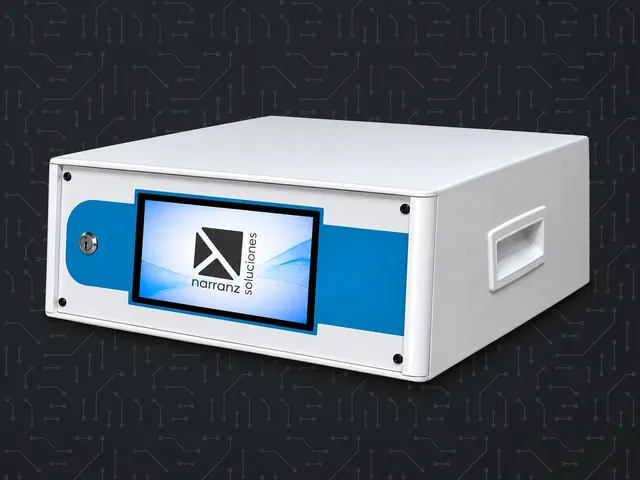
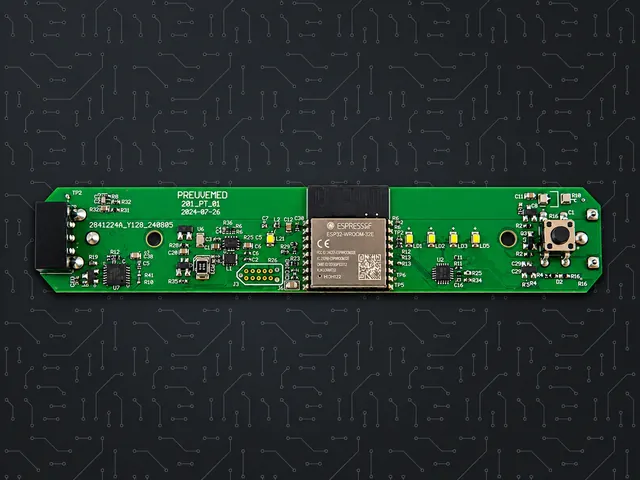
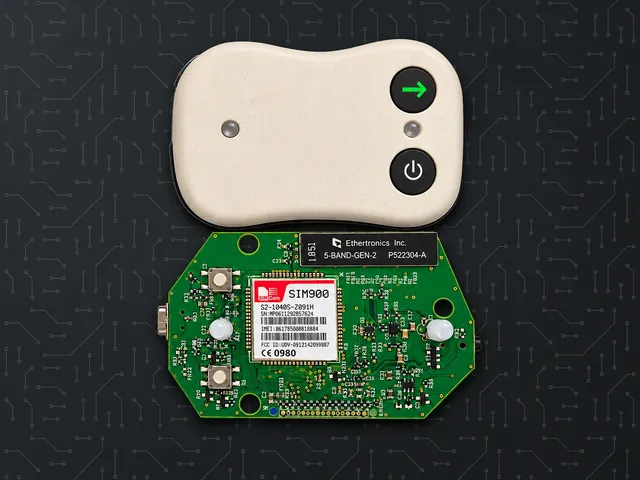
This access control thermometer performs non-contact wrist temperature measurement. ToF distance measurement controls the thermometer's distance, so every user is positioned at the same distance before the reading: the result is an autonomous access control terminal delivering repeatable measurements. As a Wi-Fi thermometer and Bluetooth thermometer, it can also be configured and integrated into the building network.
The unit is based on a RISC-V architecture running the FreeRTOS operating system and features Wi-Fi and Bluetooth communications, a 5-inch touchscreen, a rechargeable battery and a Qi wireless charging system built into the base.
The measurement is taken by bringing the wrist close to one side of the terminal. To ensure correct positioning, the system includes a ToF (Time of Flight) sensor that continuously measures the distance between the wrist and the measurement area. The graphical interface tells the user whether to move the wrist closer or further away, and acquisition only starts once the wrist is within the set range.
This combination of non-contact thermal measurement, ToF distance control and a guided graphical interface improves the repeatability of the process and reduces errors caused by incorrect positioning.
Non-contact temperature measurement
The device measures temperature without any physical contact between the user and the sensor.
To start the process, the user brings the wrist close to the measurement area on one side of the terminal.
The electronics automatically monitor positioning and, once the conditions defined for a reading are met, perform the temperature acquisition and show the result on the display.
This avoids direct contact with the unit during measurement and makes it easy for different users to use it one after another.
Wrist-approach measurement
The system is specifically designed to take the measurement as the wrist approaches.
The display gives visual instructions that guide the user throughout the procedure, so there is no need to know the exact sensor position beforehand.
The operating cycle can be summarised as follows:
- Wrist detection
- ToF distance measurement
- Positioning
- Temperature measurement
- Processing
- Result display
The process runs automatically once the wrist is correctly positioned.
ToF sensor for distance control
A distinctive feature of the unit is a dedicated ToF (Time of Flight) sensor that determines the distance between the wrist and the temperature sensor.
ToF technology calculates distance from the time of flight of an optical signal, giving the system accurate information on the position of the wrist relative to the measurement area.
This information is used to verify that the user is within the distance range defined for acquisition.
Automatic positioning guidance
When the wrist is too far from the sensor, the graphical interface tells the user to move it closer.
If it is too close, the terminal asks the user to move it away.
When the ToF sensor determines that the correct position has been reached, the system automatically enables temperature measurement.
The sequence can be represented as follows:
- Wrist too far
- MOVE CLOSER
- Wrist too close
- MOVE AWAY
- Correct distance
- TAKE MEASUREMENT
This mechanism establishes more consistent geometric conditions from one measurement to the next.
Improved measurement repeatability
In a non-contact temperature measurement system, the distance from the sensor can affect acquisition conditions.
The ToF sensor allows this parameter to be controlled before the reading is taken, preventing each user from placing the wrist at a different distance.
The system therefore does more than take a thermal reading: it first verifies the position of the wrist and guides the user to the defined measurement area.
This improves the consistency and repeatability of the procedure.
5-inch touchscreen
The terminal features a 5” touchscreen that serves as the main user interface.
The display can show instructions, graphics, positioning messages, process status and the result of the operation.
During measurement, the interface can dynamically report the different phases:
- Bring your wrist closer
- Adjust the distance
- Measuring
- Measurement complete
The graphical interface enables an intuitive procedure that reduces the need for external assistance.
Dynamic graphical interface
A graphical display allows the terminal's behaviour to be adapted to different environments and procedures.
Messages can combine text, icons, animations and visual cues to make interaction easier for the user.
It also supports multiple languages and allows the user experience to be modified through software updates.
Stand-alone access control terminal
The device is designed as a stand-alone terminal for installation at access points.
Its pedestal format allows it to be placed at entrances, receptions and walkways, providing an accessible interface for users.
Local processing means the entire positioning and acquisition procedure is carried out on the terminal itself, without an external computer.
RISC-V architecture
The system uses a processor based on the RISC-V architecture to coordinate the device's various functions.
The controller manages the temperature sensor, ToF sensor, touchscreen, wireless communications, battery, graphical interface and other peripherals.
The embedded architecture integrates measurement, control and user interface functions on a single electronic platform.
FreeRTOS operating system
The firmware is developed on FreeRTOS, providing a real-time architecture to manage the terminal's various functions.
The software can be structured as independent tasks responsible for:
- Temperature acquisition
- ToF distance measurement
- Touchscreen management
- Graphical interface
- Wi-Fi communications
- Bluetooth communications
- Power and battery management
- System diagnostics and supervision
- This architecture ensures a fast response to events generated during the measurement process
Wi-Fi communications
The terminal features Wi-Fi connectivity, allowing it to be integrated into a wireless communications infrastructure.
Depending on the installed application, the connection can be used for configuration, maintenance, updates and communication with other systems.
This allows multiple terminals to be integrated into a connected infrastructure and simplifies their management, as certain operations do not require physical access to each device.
Bluetooth communications
In addition to Wi-Fi, the system includes Bluetooth for short-range wireless communications.
This interface can be used for configuration, commissioning, diagnostics or communication with nearby devices.
The combination of Wi-Fi + Bluetooth provides the flexibility to implement both infrastructure communications and local connections.
Rechargeable battery power
The terminal has an internal rechargeable battery, so it can operate without a permanent physical connection to a power supply.
This gives greater freedom of installation and makes it easy to move or reposition the unit when required.
The electronics manage power to the various subsystems to optimise energy consumption and monitor battery status.
Qi wireless charging
The system features Qi wireless charging, removing the need to plug a power cable into the terminal manually during routine recharging.
The Qi charger is built into the base of the system.
When the device is placed in its charging position, the battery recharges through wireless power transfer.
This simplifies maintenance and reduces the wear associated with repeated use of physical connectors.
Base with integrated charger
The terminal base serves as both physical stand and charging station.
The integrated Qi charger keeps the device ready for use and provides a tidier installation.
The unit can be removed from its position when required and put back later to recharge.
Power management
Battery operation requires efficient management of the various subsystems.
The electronics can control the display, sensors and communications to adapt consumption to the different phases of use.
The RISC-V and FreeRTOS platform makes it possible to coordinate operating states and implement specific energy-saving strategies.
Autonomous operation
The combination of sensors, local processing, touchscreen and battery allows the device to operate as a fully autonomous terminal.
The unit itself guides the user, checks the distance, takes the measurement and displays the result.
No smartphone, computer or external device is needed to complete the normal measurement procedure.
Diagnostics and maintenance
The processing and communication capabilities allow diagnostic functions to be implemented across the unit's subsystems.
The terminal can monitor elements such as the thermal sensor, ToF sensor, display, communications and battery status.
Wi-Fi and Bluetooth also provide interfaces that can be used to simplify configuration and maintenance tasks.
Key advantages
- Non-contact temperature measurement as the wrist approaches
- ToF sensor to verify the measuring distance automatically
- Visual guidance telling the user when to move the wrist closer or further away
- Measurement enabled only once the set distance range is reached
- 5” touchscreen with graphical interface
- RISC-V architecture and FreeRTOS
- Wi-Fi and Bluetooth communications
- Autonomous battery operation
- Qi wireless charging
- Charger built into the base
- Designed specifically for access control points
Applications
The system is intended for access control points, corporate buildings, industrial facilities, receptions, workplaces and self-service terminals where non-contact temperature measurement is required.
The same technology platform can be adapted to other applications that need to combine proximity sensors, non-contact measurement, a graphical interface, wireless communications and battery operation.
Technical specifications
| Device type | Non-contact measurement terminal |
|---|---|
| Application | Access control |
| Measurement area | Wrist |
| Measurement | Non-contact |
| Distance control | ToF sensor |
| Distance technology | Time of Flight |
| Positioning guidance | Move closer / move away |
| Distance validation | Automatic |
| Architecture | RISC-V |
| Operating system | FreeRTOS |
| Display | 5” touchscreen |
| Interface | Graphical and touch |
| Wi-Fi | Yes |
| Bluetooth | Yes |
| Power supply | Rechargeable battery |
| Charging | Wireless |
| Charging technology | Qi |
| Charger | Built into the base |
| Operation | Autonomous |
| Installation | Terminal / pedestal |