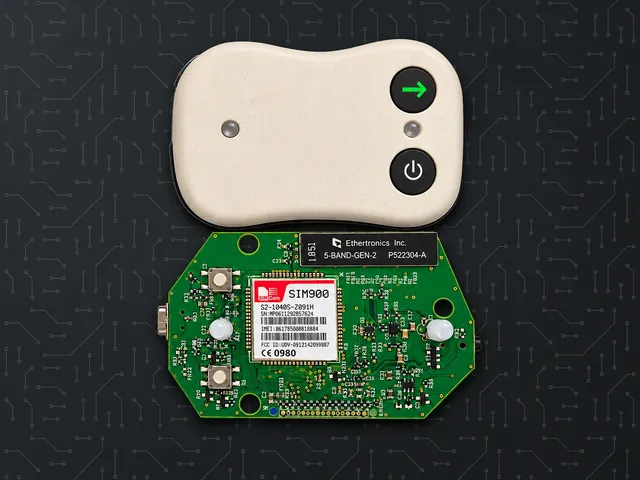
This portable potentiostat and BLE potentiostat takes electrochemical instrumentation out of the laboratory. As a Bluetooth potentiostat built on RISC-V and FreeRTOS, it handles electrochemical sensor acquisition and electrochemical measurement for any electrochemical sensor, such as an amperometric sensor, and sends the results straight to a mobile phone.
The device is based on a RISC-V architecture running the FreeRTOS operating system and includes the analogue electronics needed to energise the electrochemical sensor and measure the currents generated during the process.
Battery operation and BLE connectivity make it a portable measurement system, avoiding cable connections to external equipment during use.
An LED array with progressive brightness control gives visual feedback on the progress of the measurement, letting the user see at a glance when the sensor is stabilising and when acquisition is complete.
Electrochemical sensor measurement
The unit acts as the electronic interface between the electrochemical sensor and the application that processes or displays the results.
The electronics apply the required electrical conditions to the sensor and measure the currents generated as the electrochemical response.
The system then digitises the measurements so that they can be processed by the device and transmitted over Bluetooth.
This architecture brings excitation, acquisition, processing and wireless communication together in a single device.
Potentiostatic sensor control
The analogue stage is designed to establish and maintain the electrical conditions required while the electrochemical sensor is being measured.
The RISC-V controller coordinates the measurement sequence and the timing needed to carry out the process correctly.
In simplified form, the operating cycle can be represented as follows:
- Activation
- Sensor energisation
- Stabilisation
- Current measurement
- Processing
- BLE transmission
- Result
This sequence automates the procedure and reduces the amount of user intervention required.
Electrochemical current measurement
During the process, the electronics acquire the current generated by the sensor in response to the applied excitation.
These signals can be very small, which makes the acquisition stage a key part of the potentiostat design.
After conditioning and digitisation, the processor can perform any necessary processing before sending the results to the mobile app.
RISC-V architecture
The device uses a RISC-V architecture to coordinate the entire measurement process.
The processor controls the excitation sequence, current acquisition, timing, the LED user interface and Bluetooth communications.
An embedded architecture allows all of these functions to be integrated into a compact, battery-powered device.
FreeRTOS operating system
The firmware is based on FreeRTOS, organising the device's functions into independent tasks.
The software architecture can separate electrochemical sensor management, data acquisition, timing, BLE communications, LED signalling and power management.
This supports deterministic operation throughout the different phases of the measurement process.
Bluetooth Low Energy
Bluetooth Low Energy (BLE) connectivity allows the potentiostat to communicate directly with smartphones, tablets and other compatible devices.
The results obtained from the sensor and information on the measurement status can be transmitted over BLE.
Wireless communication removes the need to physically connect the unit to a computer during use and makes it easier to develop portable measurement solutions.
Mobile app integration
The device is designed to work together with a mobile app that acts as the user interface.
The app can receive the results transmitted over BLE and present them clearly for review or further processing.
This architecture separates the specialised measurement electronics from the graphical interface, using the smartphone as the display and management platform.
Visual LED progress indicator
The unit features an LED array that provides visual information on the status of the process.
Because the electrochemical sensor needs a certain energisation and stabilisation time before the measurement can be completed, the LEDs graphically represent the progress of the cycle.
As the process advances, the LEDs light up in turn and gradually increase in brightness, giving the user an intuitive indication of the time remaining.
When the process reaches its final state, the signalling makes it visually clear that the measurement has finished and the result is available.
This interface means the user does not have to rely solely on the mobile app to know the status of the device.
Sensor timing and stabilisation
Energising certain electrochemical sensors requires specific conditions to be maintained for several seconds before a valid measurement can be obtained.
The firmware controls this timing automatically, so the user does not have to manage the different phases manually.
During this interval, the system maintains the corresponding excitation, tracks progress and updates the visual LED indication.
Battery operation
The device is designed to run on batteries, providing autonomy and making it easy to use as a portable instrument.
The combination of an embedded architecture and BLE communications reduces power consumption compared with higher-power wireless technologies.
Power management can keep only the subsystems required in each operating phase active, optimising the available battery life.
Portable design
With no permanent power or communication connections, the unit can be used as a portable electrochemical measurement solution.
The user can carry out the process directly at the point of use and then receive the results on a mobile device.
This approach is particularly attractive for portable instrumentation, connected sensors and measurement systems used outside the laboratory.
Applications
The platform can be used in portable electrochemical sensors, measurement instrumentation, connected analysis systems, amperometric sensors, diagnostic devices and IoT applications based on electrochemical sensors.
The architecture also allows different product variants to be developed by adapting the analogue stage and firmware to the characteristics of the sensor used.
Technical specifications
| Device type | Portable potentiostat |
|---|---|
| Application | Electrochemical sensors |
| Function | Excitation and measurement |
| Measured quantity | Sensor current |
| Architecture | RISC-V |
| Operating system | FreeRTOS |
| Wireless communication | Bluetooth Low Energy |
| User interface | Mobile app |
| Local indicator | LED array |
| Progress indication | Sequential and by brightness |
| Timing | Electronically controlled |
| Power supply | Batteries |
| Operation | Portable |
| Processing | Local |
| Result transmission | BLE |